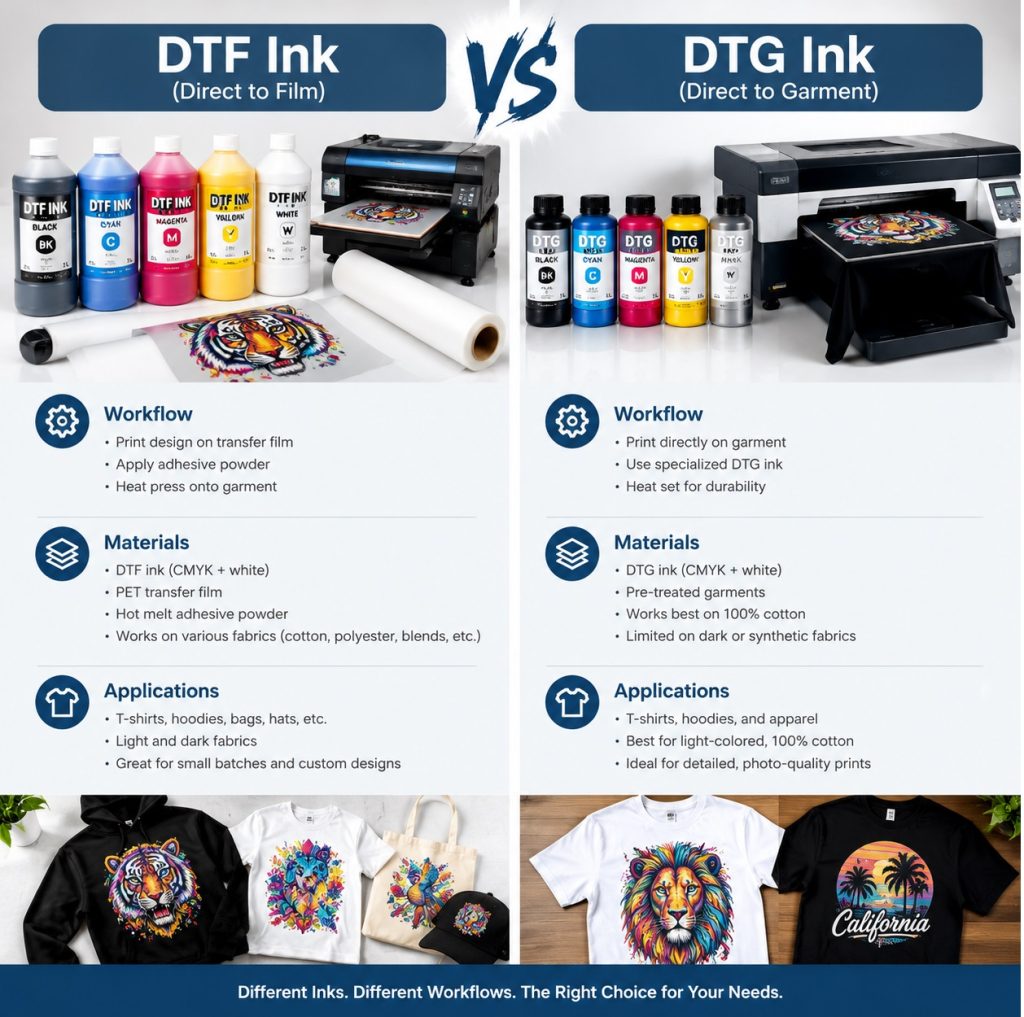
 A DTF, or direct to film, printer and a DTG, or direct to garment, printer can both put a tiger on a T-shirt. The difference shows up when you touch the fabric, count your labor minutes, or try to press a polyester hoodie. That’s why DTF ink vs. DTG ink isn’t a Pepsi vs. Coke debate. It’s a production strategy. Choose wrong, and you’ll blame the ink for problems that started with the order you accepted.
The Ink Itself
Both DTF and DTG inks are pigment-based. That’s where the family resemblance ends. DTF ink is built to land on a PET film, hold a crisp image, and bond with a hot-melt adhesive powder. It has to survive being printed, powdered, cured, stored, and then heat pressed onto a garment. DTG ink is built to be jetted straight into a pretreated fabric. It needs to stay stable in the printhead, sit on top of cotton fibers without bleeding, and cure into a finish that feels like part of the shirt. Swap them and you’re not being clever. You’re ordering a service call.
Workflow: Film vs. Garment
DTF is a transfer process. You print the design onto film, apply adhesive powder, shake off the excess, cure the transfer, and then press it onto the final item. The garment never touches the printer. That one fact changes everything. You can print a batch of transfers on Monday, press them on Wednesday, and ship them from a different room, city, or fulfillment partner. You can stock popular designs as transfers and press them as orders arrive. For shops that sell online, that decoupling is gold. It means you can produce during slow hours and personalize later.
DTG is a direct process. The garment goes on a platen, gets pretreated if needed, gets printed, then gets cured. There’s no film, no powder, no transfer inventory. The upside is a shorter path from blank to finished shirt. The downside is that the printer is tied to the garment. You can’t print a stack of DTG designs and press them later. You need the shirt in front of you. Pretreatment adds another step, especially on dark colors, and that step has its own learning curve. Too much pretreat and the print looks fried. Too little and the white ink cracks or fades. DTG rewards operators who like consistency and control. DTF rewards operators who want flexibility and batch production.
Materials: What Each Ink Actually Likes
DTF ink is the social butterfly. It can transfer onto cotton, polyester, blends, nylon, leather, denim, canvas, and more, provided the transfer is pressed correctly for that material. It’s a strong choice for dark garments because the white ink sits on the film and transfers as a bright base. It also handles synthetic fabrics that make DTG sweat. If your customers bring you team jerseys, performance wear, tote bags, and caps, DTF gives you room to say yes.
DTG ink is pickier. It performs best on 100 percent cotton or high-cotton blends. That’s where the water-based pigment can bond with the fabric and deliver a soft, breathable feel. On polyester, DTG can struggle with dye migration, poor opacity, and a hand feel that’s less than premium. Some blends work with the right pretreatment and finishing, but they demand testing. If your business is built on cotton tees, DTG can produce a print that customers describe as barely there. If your business is built on poly hoodies and nylon jackets, DTF is usually the safer bet.
Applications: Where Each One Earns Its Keep
DTF shines for small runs, dark garments, synthetic materials, and designs with lots of colors. It’s also a great fit for transfer libraries. Print 50 transfers of a best-selling design, keep them organized, and press them as orders come in. That can smooth out production spikes and reduce shipping delays. The trade-off is hand feel. DTF transfers have a slight film-like texture, especially on large solid areas. On a heavy hoodie, most customers won’t care. On a lightweight summer tee, they might.
DTG shines for cotton apparel that needs a soft, retail-quality print. Think premium tees, brand merch, henleys, and baby clothes. It’s excellent for photorealistic images, fine gradients, and all-over placement on cotton garments. It’s also a natural fit for print-on-demand shops that want to print one shirt at a time without dealing with film and powder. The trade-off is material limits and pretreatment. DTG is not the tool for every blank in your catalog.
The Business Decision
Marketing a custom apparel business is really marketing a promise. If you promise soft cotton prints, DTG helps you keep it. If you promise fast turnaround on dark poly jerseys, DTF helps you keep it. If you promise both, you probably need both. That’s not a cop-out. It’s the reality of a market where customers want choices and shops need margins.
Don’t compare DTF ink and DTG ink by bottle price. Compare the whole workflow. Add up film, powder, pretreatment, curing, labor, waste, and the cost of a ruined garment. Then look at your order history. What do people actually buy from you? If it’s cotton tees with soft prints, DTG earns its place. If it’s dark blends, small batches, and odd materials, DTF usually wins. If you’re scaling a print-on-demand brand, DTF transfers can give you inventory without finished goods. If you’re decorating locally and want the shortest path from blank to box, DTG keeps it simple.
The smartest shops don’t ask which ink is better. They ask which ink fits the order in front of them. DTF and DTG are not rivals fighting for the same crown. They’re two production models wearing similar names. Match the ink to the workflow, the material, and the customer promise. That’s how you stop selling prints and start selling outcomes.