 A flexible coupling can forgive a lot. It cannot forgive a hammer.
I have watched crews spend six hours aligning a pump train, then destroy the coupling in six minutes because someone drove the hub on with a dead blow and called it close enough. The coupling is not a sacrificial part. It is a precision connection that happens to tolerate some misalignment, torque fluctuation, and vibration. Install it like it matters, and it will outlast the equipment around it. Install it like an afterthought, and you will be buying downtime by the hour.
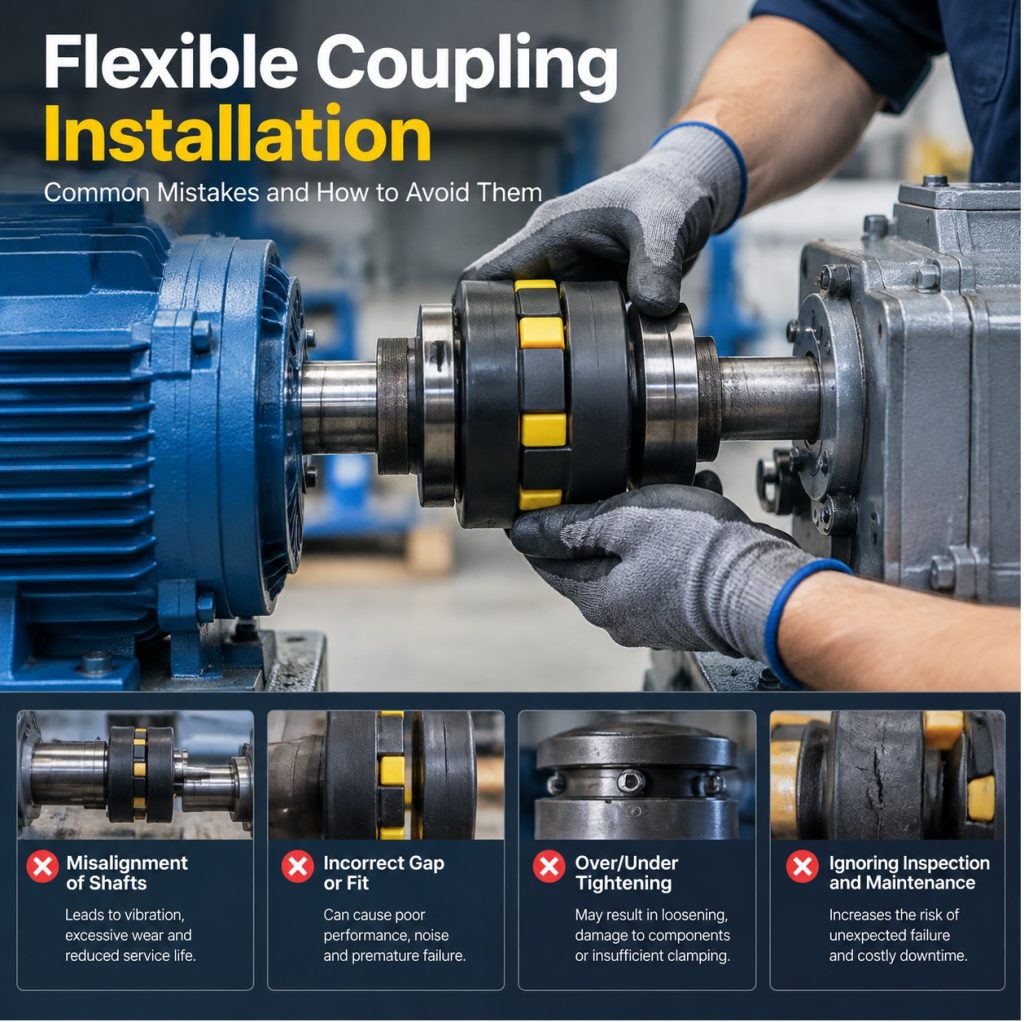
Mistake 1: Using the coupling to fix misalignment. Flexible couplings are not alignment erasers. They have limits. Every coupling has allowable parallel, angular, and axial misalignment. If you rely on the flex element to soak up a bad foundation or pipe strain, you are trading a small alignment job for premature failure. Avoid it by aligning the shafts first, then installing the coupling. Check cold and hot conditions. Account for thermal growth. Verify soft foot before you touch a shim.
Mistake 2: Hammering hubs onto shafts. This is the one that makes field engineers twitch. Hammering damages bearings, brinells races, distorts hubs, and creates micro-cracks. If the fit is interference, use the manufacturer approved method: induction heater, oil bath, or hydraulic fit. Never heat an elastomeric coupling hub with an open flame. Never pound on a disc pack or a spacer. If it will not go on with light pressure and the right temperature, stop and measure. The shaft or hub is probably out of tolerance.
Mistake 3: Ignoring runout and concentricity. You can have perfect shaft alignment and still get vibration because the coupling hubs are eccentric or the faces are out of square. Check radial and axial runout on each hub. Use a dial indicator or laser system. If runout exceeds spec, do not adjust it with force. Find the burr, the damaged key, the bent shaft, or the bad fit. A coupling that wobbles is a coupling that is already failing.